
BrainX Waves: The Newsletter of BrainX Community
November 2025: Issue 16

Learn
Will AI replace healthcare professionals?
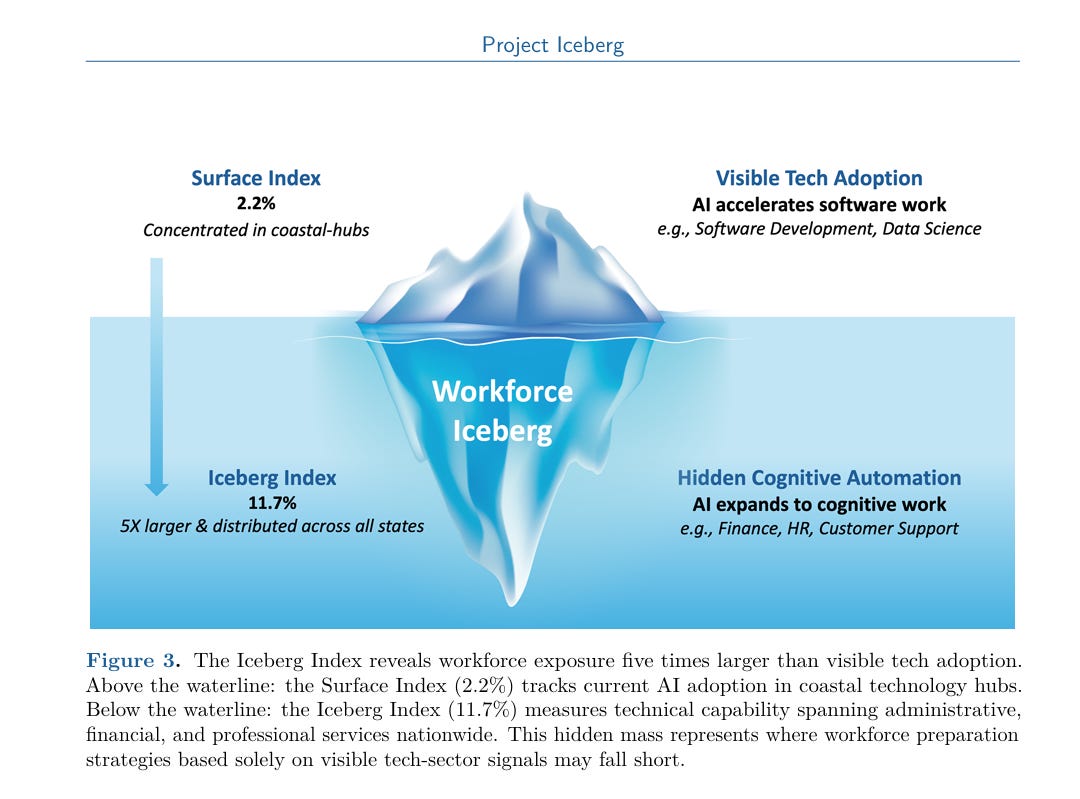
There are ever increasing concerns about AI replacing the human workforce. In a recently published study from MIT,the researchers of Project Iceberg,defined the Iceberg Index as a measure of AI technical capabilities that overlap human occupational skills.1 They concluded that in the US, AI technical capability extends to cognitive and administrative tasks spanning 11.7% of the labor market including in healthcare.1 So, are healthcare professionals vulnerable? So, which tasks currently performed by healthcare professionals are likely to be replaced by AI? Dr. Maheshwari, recently wrote an interesting viewpoint article articulating the tasks currently performed by Anesthesiologists.2 Similar to the Project Iceberg, he describes the overlap between AI technical capabilities and human skills across 12 domains.
Such projections and prophecies have been made in the past by many renowned scholars. But with the introduction of Generative AI tools, many tasks mimic human capabilities and such tools are seeing rapid adoption. Based on a recently conducted study, in which both physicians and patients were surveyed, the Dr. Saasouh noted varying degrees of comfort and trust from both physicians and patients with the use of AI in medicine.3 These results are not different from a multinational survey of in-hospital patients,performed across 6 continents, the patients indicated a predominantly favorable general view of AI in health care.4 Thus, our patients are seeking and are comfortable with the use of AI in their healthcare.
So, how best can we prepare ourselves for the future? Or should we say near term present? With growing applications of AI in healthcare getting FDA approval, even in specialized fields such as Anesthesiology,5 there are some common recommendations being proposed by various think-tanks, as listed below.
Educate yourself about AI and potential uses in healthcare.6
Join a community for continuous learning in this fast evolving sector.7
Engage in development of new care delivery models leveraging AI.2
Partner with solution developers to guide, evaluate and validate the development of AI solutions for healthcare.8
Lead in development of implementation science of AI in healthcare.9
Educate the patients about appropriate use of AI technologies.7
Advocate for safe and cost-effective use of AI and human resources in healthcare.10
At BrainX (https://www.brainxai.com/), we are focused on following up with all of the above recommendations for implementation of AI in healthcare. Read more about our research here: https://www.brainxai.com/research
Reference publications:
https://open.substack.com/pub/kamalmaheshwari/p/my-fellow-anesthesiologists-lets
Awasthi, R., Bhattad, A., Ramachandran, S.P. et al. Human evaluation of large language models in healthcare: gaps, challenges, and the need for standardization. npj Health Syst. 2, 40 (2025). https://doi.org/10.1038/s44401-025-00043-2
Nicolson, A., Bradburn, E., Gal, Y. et al. The human factor in explainable artificial intelligence: clinician variability in trust, reliance, and performance. npj Digit. Med. 8, 658 (2025). https://doi.org/10.1038/s41746-025-02023-0
https://themedicaltech.com/strategic-and-value-based-implementation-of-generative-ai-in-healthcare/
Connect
Watch the recording of our recent BrainX Community Live! November 2025 event, featuring Dr. Ashish Atreja, Founder, Genserve.AI. There is a growing need to adopt a platform based approach to adopt GenerativeAI at healthcare systems. 95% of GenAI pilots fail and many are due to the lack of a unified and systematic approach. Genserve.AI is a platform to deliver on launch with Enterprise-wide Secure Gen AI within 30 Days. It promised to bring trustworthy AI to all employees through our HIPAA-compliant GenAI delivery and vendor neutral monitoring platform. Learn more about their approach through this event recording.

Learn more about Genserve.ai
Datasets (Open source)
STARC-9 (STAnford coloRectal Cancer WSI)
STARC-9 (STAnford coloRectal Cancer): A large-scale dataset with 630k samples across nine tissue types (~70k per class) collected from over 200 WSI for multi-class tissue classification task. Stanford and TCGA-CRC tile-level validation datasets. Pretrained model weights on STARC-9, including baseline, SOTA, and Pathology-specific foundation models.Open-source code repository for DeepCluster++ framework that can be used for image sample collection across domains.
MIMIC-IV-Ext-22MCTS: Time-Series Dataset
Clinical risk prediction based on machine learning algorithms plays a vital role in modern healthcare. A crucial component in developing a reliable prediction model is a high-quality dataset with time series clinical events. In this work, the authors release such a dataset that consists of 22,588,586 clinical time series events, which is term MIMIC-IV-Ext-22MCTS. The source data are discharge summaries selected from the well-known yet unstructured MIMIC-IV-Note. The authors then extract clinical events as short text spans from the discharge summaries, along with the timestamps of these events as temporal information by contextual retrieval and Llama-3.1-8B.
This dataset contains data from 2280 participants that was collected between July 19, 2023 and May 01, 2025. Data from multiple modalities are included. The AI-READI is a dataset consisting of data collected from individuals with and without Type 2 Diabetes Mellitus (T2DM) and harmonized across 3 data collection sites. The composition of the dataset was designed with future studies using AI/Machine Learning in mind. This included recruitment sampling procedures aimed at achieving approximately equal distribution of participants across diabetes severity, as well as the design of a data acquisition protocol across multiple domains (survey data, physical measurements, clinical data, imaging data, wearable device data, etc.) to enable downstream AI/ML analyses that may not be feasible with existing data sources such as claims or electronic health records data. The dataset contains 358,999 files and is around 3.87 TB in size.
HC4 (Healthcare Comprehensive Commons Corpus)
HC4 is a large-scale pretraining dataset containing over 65 billion tokens from diverse healthcare-related sources. The corpus was curated to enable systematic investigation of how data composition influences language model behavior, including potential demographic biases. 153GB (around 65 billion tokens). 9.7+ million documents from diverse sources including peer-reviewed scientific literature collected from PubMed Central, Semantic Scholar, OpenAlex repositories.
Conferences

Additional BXC-featured publications
Cardiology/Generative AI
Comprehensive echocardiogram evaluation with view primed vision language AI
Vukadinovic, M., Chiu, IM., Tang, X. et al.
Book
AI in Medicine: Clinical Updates & Physician Perspectives
Amit Kumar Dey, Ashlesha Tawde-Kelkar
Course
AI in Medicine Graduate Certificate
Book
Generative AI: Unlocking the Next Chapter in Healthcare
Rohit Mahajan , Ritu M. Uberoy
Generative AI/LLM
Evaluating clinical AI summaries with large language models as judges
Croxford, E., Gao, Y., First, E. et al.
Generative AI/LLM
Quantifying the reasoning abilities of LLMs on clinical cases
Qiu, P., Wu, C., Liu, S. et al.
Cardiology/Generative AI/LLM
Comprehensive echocardiogram evaluation with view primed vision language AI
Vukadinovic, M., Chiu, IM., Tang, X. et al.
Join and follow the BrainX community!
Webpage: https://brainxai.org/
Newsletter: https://brainxai.substack.com/subscribe
LinkedIn: https://www.linkedin.com/groups/13599549/
Youtube: https://www.youtube.com/channel/UCua5EiLL6I29hpNrJsdv1rg
The fact is healthcare saw the biggest increase in jobs in the past decade. We also know the healthcare cost is bankrupting our society. It’s not only logical but existential to use AI in healthcare.