
BrainX Waves: The Newsletter of BrainX Community
July 2026: Issue 24

Learn
Harnessing Generative AI for Responsible Evidence Synthesis in Health Professions Education
Generative artificial intelligence is creating a new opportunity to transform evidence synthesis from a slow, largely manual process into a more scalable and interactive component of healthcare education. A recent scoping review of 517 publications found rapidly expanding use of generative AI across medicine, nursing, dentistry, pharmacy and allied health education, particularly for generating educational materials and evaluating assessment items.1 This growing body of work suggests that generative AI could help educators rapidly summarize literature, create case-based learning resources, tailor content to learner needs and support more continuous updating of curricula as evidence evolves. By reducing the time required to find, organize and translate information, these tools may enable educators and learners to devote greater attention to critical appraisal, clinical reasoning and the application of evidence rather than information retrieval alone.
The emerging evidence also shows that performance is highly dependent on the tool, task and evaluation setting. General-purpose frontier models outperformed specialized clinical tools on standardized benchmarks and selected physician questions, whereas a separate specialty-matched evaluation of real point-of-care queries found that a clinically customized platform was preferred by physicians for accuracy, usefulness, source quality, verifiability and completeness.2,4 A pilot study of complex subspecialty scenarios further reported modest accuracy and variable repeatability, despite improved performance with a deeper evidence-search mode.3 These apparently mixed findings are not a setback; rather, they demonstrate that evidence synthesis cannot be judged by a single benchmark. Larger independent studies, transparent reporting, representative clinical questions, expert evaluation and outcome-focused educational research are now needed. Together, these studies point toward a productive future in which generative AI complements,not replaces, human expertise, accelerating access to evidence while strengthening the role of educators and clinicians as critical interpreters and trusted validators.
References
Edara R, Highum B, Damania R, et al. Generative AI research in health professions education: a scoping review. Med Sci Educ. Published online June 30, 2026. doi:10.1007/s40670-026-02810-8.
General-purpose chatbots outperform clinical AI tools on physicians’ real-world questions. Nat Med. 2026;32:2364–2365. doi:10.1038/s41591-026-04457-9.
Jagarapu J, Babata K, Chamarthi S, Hoyt R. The accuracy and repeatability of OpenEvidence on complex medical subspecialty scenarios: a pilot study. medRxiv. Published online December 4, 2025. doi:10.64898/2025.11.29.25341091.
Feng J, et al. Expert evaluation of clinical AI tools on real point-of-care clinical queries. arXiv. Published online June 2026. arXiv:2606.28960.
Connect
Join us for the next BrainXCommunity Live! Journal Club style Webinar , as we explore how artificial intelligence is reshaping evidence synthesis, clinical question answering, and health professions education.
Register here: https://us02web.zoom.us/meeting/register/JTwt6xcRSrSSGN5lXBT0IQ
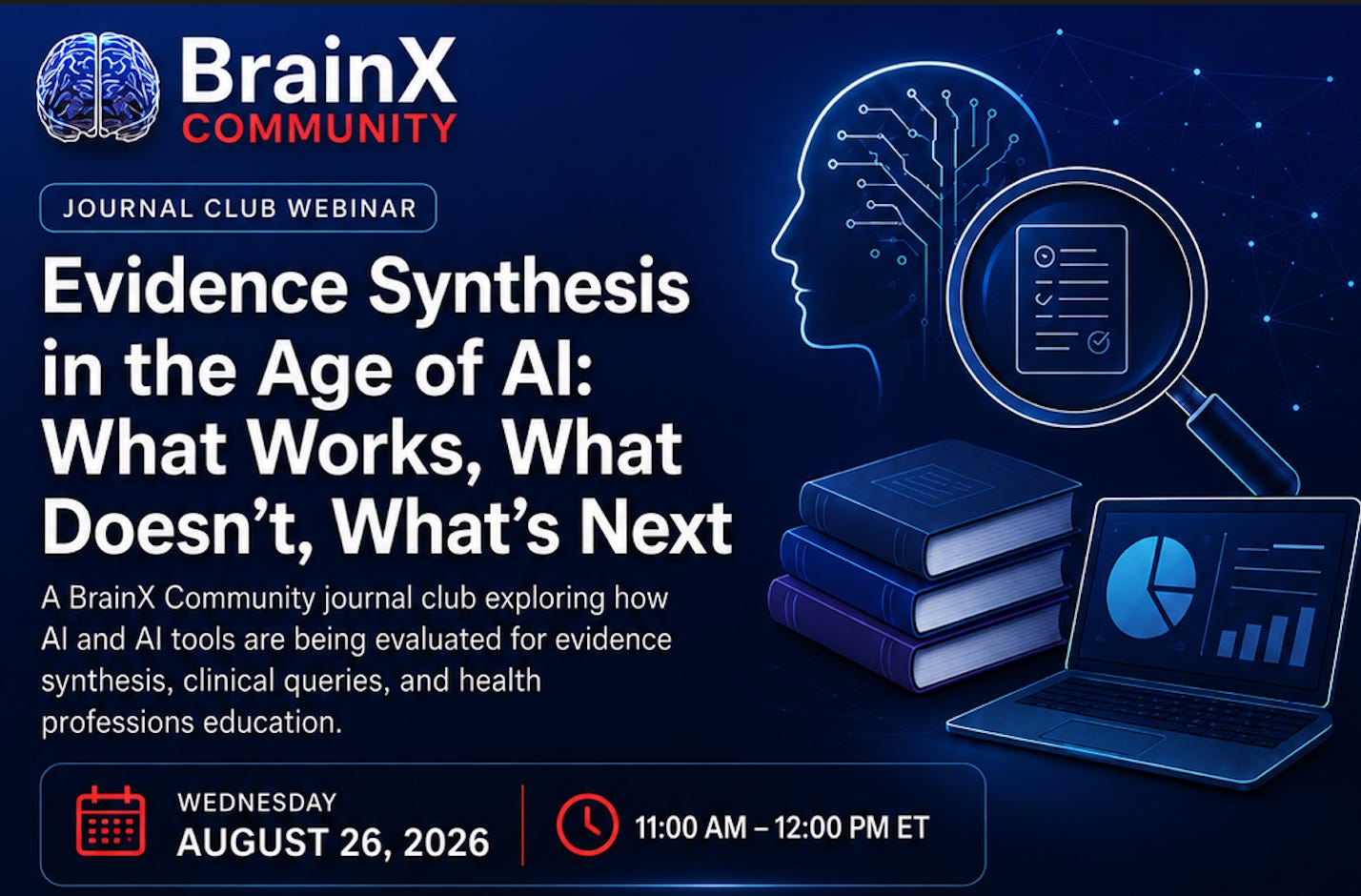
Evidence Synthesis in the Age of AI: What Works, What Doesn’t, What’s Next
Presented by Dr. Ruthvik Edara, BrainXAI ReSearch, this interactive session will examine four timely publications evaluating AI tools across real-world clinical queries, complex medical subspecialty scenarios, point-of-care decision support, and generative AI in health professions education.
📅 Wednesday, August 26, 2026
🕚 11:00 AM–12:00 PM ET
Join the discussion and help us critically evaluate what AI can do today, where it still falls short, and what comes next for trustworthy evidence synthesis in healthcare.
Program Description:
1. Introductions
2. Journal Club: Dr. Sai Ruthvik Edara, Researcher, BrainXAI ReSearch, BrainX LLC., will present the following publications:
- General-purpose chatbots outperform clinical AI tools on physicians’ real-world questions
- Expert Evaluation of Clinical AI Tools on Real Point-of-Care Clinical Queries
- Generative AI Research in Health Professions Education: A Scoping Review
- Panel discussion with Q&A
Datasets (Open source)
General
A novel dataset of patient summaries and relations called PMC-Patients to benchmark two ReCDS tasks: Patient-to-Article Retrieval (ReCDS-PAR) and Patient-to-Patient Retrieval (ReCDS-PPR). Specifically, we extract patient summaries from PubMed Central articles using simple heuristics and utilize the PubMed citation graph to define patient-article relevance and patient-patient similarity. PMC-Patients contains 167k patient summaries with 3.1M patient-article relevance annotations and 293k patient-patient similarity annotations, which is the largest-scale resource for ReCDS and also one of the largest patient collections.
Surgery
GR00T-H post-trains GR00T N1.6 on surgical robot data from multiple institutions and robot platforms simultaneously. The core challenge is that each institution records data differently — different robots, coordinate conventions, frame rates, camera setups, and state/action representations. GR00T-H solves this by defining per-embodiment modality configs that convert each dataset into a common representation (REL_XYZ_ROT6D for EEF poses) while preserving robot-specific details like clutch handling and motion scaling. The dataset contains 778 hours of real and synthetic procedure episodes.
Emergency Medicine
An open-source dataset of lung POCUS images derived from a multi-center study involving 226 adult patients presenting to emergency departments with respiratory symptoms. Images were acquired using a standardized scanning protocol (12-zone or modified 8-zone) with various POCUS devices. Videos were preprocessed to remove identifiers, and frames were extracted and standardized to 512×512 pixels using letterboxing to maintain aspect ratios. The dataset contains 1,871 video clips comprising 324,027 frames extracted and standardized to 512×512 pixels. Half of the participants (50%) had COVID-19 pneumonia.
Conferences


Additional BXC-featured publications
Course
GE Healthcare
Generative AI/LLM
Pan, J., Jian, B., Hager, P. et al.
Book
Stanislaw P. Stawicki, Thomas R. Wojda, Andries Engelbrecht
Imaging/Radiology
Health system learning enables generalist neuroimaging models
Kondepudi, A., Rao, A., Zhao, C. et al.
Generative AI/LLM
Evaluating the robustness and readiness of large frontier models in health AI applications
Gu, Y., Fu, J., Liu, X. et al.
Join and follow the BrainX community!
Webpage: https://brainxai.org/
Newsletter: https://brainxai.substack.com/subscribe
LinkedIn: https://www.linkedin.com/groups/13599549/
Youtube: https://www.youtube.com/channel/UCua5EiLL6I29hpNrJsdv1rg
The useful boundary here is that evidence synthesis and point-of-care answering are not the same evaluation task.
For clinical AI, I would want the benchmark to preserve the workflow shape: what source was retrieved, whether the question was educational or action-facing, what uncertainty remained, and which human role still owned the decision.
In surgery, that distinction matters because a tool that helps a learner organize evidence can be valuable even when it should not be allowed to convert that evidence into a readiness claim or a change in room workflow.